
B4OBVIOUS · ARTICLES
The Spinach Test
Most executives say they want people who will tell them the truth.
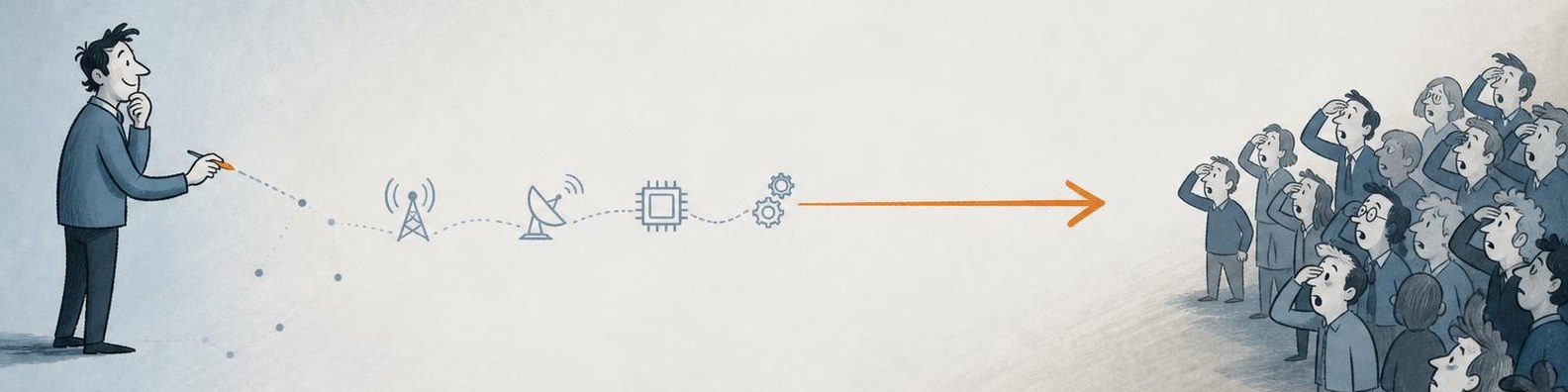
Most executives say they want people who will tell them the truth.
This is usually followed by several unspoken conditions. The truth should arrive at a convenient time, support the current strategy and avoid upsetting anybody responsible for the current strategy.
Ideally, it should also fit onto one slide.
Tim Banting offers a more practical model. If a friend has spinach between their teeth, you tell them. But you tell them privately.
It is a small metaphor for a large business problem: how to combine honesty with discretion.
Tim has spent much of his career solving that problem. His route took him from military communications during the Cold War through enterprise telephony, Cisco, Microsoft, industry research and eventually his own analyst firm, So What Now What?
The path sounds coherent when summarised. Most careers do. We remove the uncertainty, abandoned directions and badly timed training courses, then draw a neat line through the successful bits.
The reality was less orderly and more useful.
Weak signals are not conclusions
Tim’s early work placed him alongside military analysts who assembled fragments of information into broader pictures.
The process was not glamorous. There were no cocktails, car chases or watches containing small explosives. Analysts studied weak signals and tried to understand how they related.
One observation rarely meant much. Several observations, combined with context, could reveal a change in capability, behaviour or intent.
Modern businesses face a similar task.
A competitor changes its pricing. A product leader leaves. A company begins hiring people with unfamiliar skills. Customers start asking for a capability that used to sit outside the category. A vendor acquires a small firm nobody had previously considered interesting.
Each item is information. None is automatically insight.
The analyst’s job is to connect the evidence without turning it into a decorative framework for an opinion already held.
This is harder than it sounds because organisations often reward certainty more readily than curiosity. A confident answer travels quickly. A careful explanation containing conditions and probabilities may be regarded as insufficiently executive.
The difficulty is that reality remains stubbornly conditional, even after the typography has been improved.
Ask what changes next
Tim named his company So What Now What? because much market research stops at the first question: what happened?
A product was launched. A company was acquired. A market grew. An executive used the word “platform” repeatedly while standing near a large screen.
The useful questions come afterwards.
So what does this change?
Now what should a customer, competitor or investor do?
Answering those questions requires more than summarising announcements. It requires knowledge of the technology, the customer’s problem, the commercial model and the organisation attempting to deliver it.
Tim saw this clearly during the transition from traditional telephony to IP-based communications.
The established telecoms industry valued exceptional reliability. Systems evolved slowly because reliability was the product. Early IP telephony appeared less mature and occasionally was. Some hardware became warm in use. Early soft phones reproduced the layout of plastic telephones on computer screens, allowing users to press simulated buttons with a mouse.
Humanity had developed graphical computing and used it to make a telephone slightly more irritating.
Yet IP telephony had a structural advantage. Voice and data could share infrastructure. Software features could be released more quickly. Products could improve through frequent iteration rather than occasional hardware cycles.
The newcomer did not need to match the incumbent immediately on every measure. It changed which measures mattered.
The product is not the whole business
Tim joined Geotel just as Cisco acquired it, placing him inside a remarkable commercial system.
Cisco had strong products, but it also had an exceptional sales organisation, an extensive partner network, technical certifications and a repeatable method for acquiring companies.
It could partner with several young firms, observe which gained market traction and then decide whether to build, buy or continue the relationship. External companies absorbed the earliest risk. Cisco selected technologies that could fit its broader machine and scale through its channels.
This is an important lesson in technology markets. Products do not compete alone.
They arrive with sales coverage, distribution, financing, implementation skills, brand trust and relationships. A technically elegant product can lose to one that is easier to buy, deploy and support.
Strong commercial machines create their own risks. Portfolios expand. Teams find increasingly precise segments requiring slightly different products. Complexity accumulates one reasonable decision at a time.
Cisco once had a broad selection of IP phones offering different buttons, screens and accessories. Each probably had an internal justification. Collectively, they could make choosing a telephone feel like a procurement transformation programme.
Growth often produces this effect. Companies begin by solving customer problems and eventually start solving the problem of having many internal product teams.
Trust requires the possibility of disagreement
Tim later worked in market intelligence inside Cisco and Microsoft before moving to the analyst side.
That shift exposed a tension in commercial research.
The client pays for the analysis. The client may also dislike the analysis.
Some managers wonder why an analyst they fund has not ranked their company first. But if payment automatically produced praise, the research would have limited value. Everyone could declare themselves a leader and return to more pressing matters, such as redesigning the quadrant.
An analyst earns trust by being willing to disagree. The manner of disagreement matters.
Public criticism can attract attention but make improvement less likely. Private criticism gives the company room to examine the problem without first defending itself before an audience.
That is the spinach test.
Tell the client what is strong. Explain what genuinely differentiates the business. Then identify the flaw before customers or competitors do it more expensively.
Honesty without discretion may become theatre. Discretion without honesty becomes paid reassurance.
The balance is commercially valuable because strategic failure often begins with the quiet disappearance of dissent. Once employees learn that bad news is punished, executives receive increasingly cheerful reports about increasingly serious problems.
The organisation becomes aligned because everybody with an alternative view has stopped talking.
Chief executives create the weather
Tim’s experience at Cisco and Microsoft also showed how a chief executive influences thousands of people who may never meet them.
John Chambers created a Cisco culture strongly focused on customers and partners. Steve Ballmer brought intense energy and competitive urgency to Microsoft. Their behaviour travelled through management layers because people noticed what attracted attention, approval and promotion.
This is how leaders shape culture.
Not through value statements, which frequently sound as though they were written by a committee attempting to avoid a decision. They shape culture through repeated reactions.
What happens when someone brings bad news?
What questions are asked after a failure?
Who gets promoted: the person who identifies a risk or the person who protects the preferred story?
The chief executive creates the weather. Everyone else learns whether to carry an umbrella, build a shelter or insist that the rain is a strategic form of sunshine.
AI needs judgment, not faith
Tim applies the same analytical caution to artificial intelligence.
He sees practical value in tools that generate software, create flexible interfaces and help organise personal workflows. But he separates utility from economic justification.
A technology can be useful without every investment being wise. It can transform an industry while destroying capital in several enthusiastic corners of that industry. The internet managed both.
AI also carries physical and operational costs. Models depend on data centres, chips, energy, cooling and continuing investment. Businesses must address privacy, regulation, data quality and validation. Generated material still requires people who understand enough to recognise when a confident answer is wrong.
This is not an argument for dismissing AI. It is an argument for treating it like technology rather than weather from the gods.
Ask what task improves. Measure the outcome. Include the full cost. Keep experienced people close enough to detect nonsense.
Automation without judgment can produce errors more quickly, which is technically a productivity gain but rarely one celebrated in the annual report.
Build depth and range
Tim’s career advice is to become T-shaped.
The vertical part represents deep expertise in a serious domain. The horizontal part represents communication, collaboration, selling and the ability to work across boundaries.
Depth creates authority. Breadth allows that knowledge to travel.
This matters because products and categories do not remain still. Telephony became software. Voice, video and messaging converged. Unified communications moved towards contact centres and customer experience. AI is now changing how users interact with all of them.
Nobody can produce a reliable map of an entire career before starting it.
A better approach is to develop skills that help when the map changes: observe carefully, learn deeply, communicate clearly and become trusted enough to deliver an uncomfortable conclusion.
The future rarely becomes obvious at once. It arrives through weak signals, awkward early products and changes in customer behaviour.
The trick is to notice before the explanation becomes fashionable.
And, occasionally, to mention the spinach.
Further reading
- Cultivating Everyday Courage — Harvard Business Review
- How to Disagree with Someone More Powerful than You — Harvard Business Review
- AI investment bubble inflated by trio of dilemmas — Reuters Breakingviews
- Artificial intelligence technology behind ChatGPT was built in Iowa — with a lot of water — Associated Press
- Walmart and other US companies want to build a pipeline of skilled tradespeople — Associated Press
- Deflating the fear of AI — Economist Education