
B4OBVIOUS · ARTICLES
A career built from useful detours
Dan Freeman’s career does not resemble a ladder. It looks more like a workshop bench: several projects underway, tools borrowed from unrelated disciplines and at least one component whose original purpose has become irre
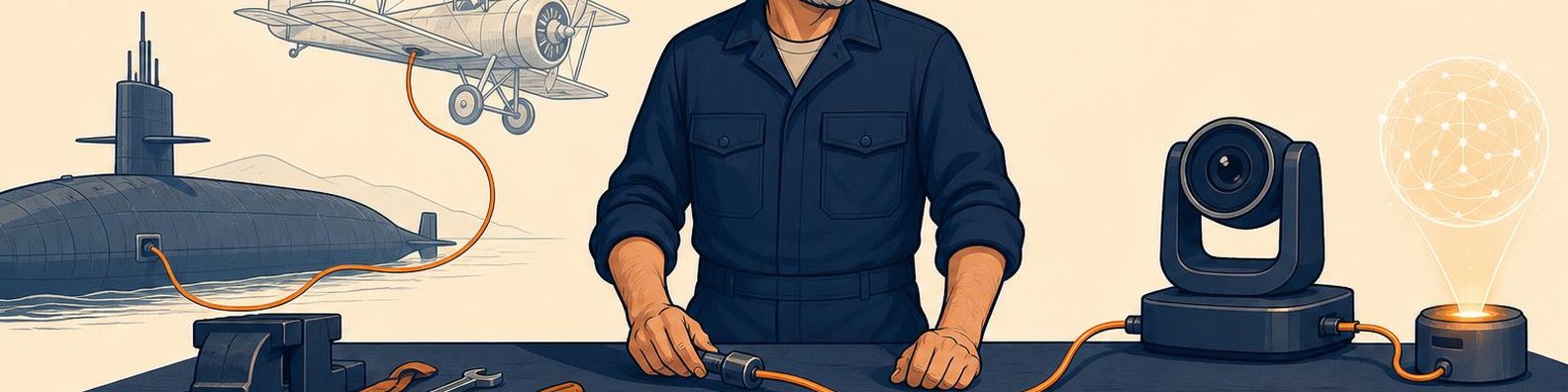
Dan Freeman’s career does not resemble a ladder. It looks more like a workshop bench: several projects underway, tools borrowed from unrelated disciplines and at least one component whose original purpose has become irrelevant.
Before entering audiovisual technology, Freeman served in the United States Navy as a P-3 aircrewman involved in submarine hunting and rescue swimming. After an injury ended his ability to fly, he studied civil engineering, painted commercial signs, trained as an aircraft mechanic and worked with fiber-optic infrastructure.
None of this was part of a polished plan to become an AV entrepreneur. It did, however, produce a valuable collection of capabilities: mechanical reasoning, visual thinking, communications knowledge and the confidence to diagnose unfamiliar systems.
His entry into video conferencing began during a cable installation near Seattle. He saw the wiring behind a customer’s entertainment system, reorganized it and was asked for his résumé. Soon afterward, he had to choose between joining Boeing as a line mechanic and working for a small video-conferencing company.
He chose video.
Learning from the installation site
Freeman entered the industry during the ISDN era, when a video call could require six digital telephone lines operating together. The technology was expensive and frequently difficult, creating a useful habitat for field engineers who could make incompatible systems cooperate.
He worked through the transition from ISDN to IP networks and from dedicated hardware codecs to software-based systems. He estimates that he personally completed close to 3,000 installations.
This gave him a perspective that product teams often lack. He saw technology after it left the demonstration room.
A product can perform beautifully on its own and still become a nuisance when installed with everything else. Connectors are inaccessible. Documentation is incomplete. Assumptions about networks, furniture and users prove optimistic. The customer, unreasonably, expects the room to work.
Freeman eventually founded Video 360 to build products from the field engineer’s point of view. Its work included an early native USB pan-tilt-zoom camera and a PTZ camera containing an Intel i5 computer.
The broader business lesson is simple: implementation knowledge belongs in product design.
Companies often ask frontline employees for feedback after the key decisions have been made. By then, the task is not collaboration but damage reporting. Engineers, installers and support teams should be involved earlier because they encounter repeated friction before it appears in financial results.
When ‘good enough’ stops being good
Freeman is critical of the technology industry’s willingness to accept ‘good enough.’
There is, of course, a sound commercial case for it. Simpler and cheaper products can make technology accessible to far more people. Technical superiority is irrelevant if customers cannot afford, understand or deploy it.
But ‘good enough’ can also become a polite phrase for work nobody is proud of.
The challenge is distinguishing valuable engineering from perfection that serves mainly the engineer. Technical excellence without adoption creates an impressive niche. Adoption without sufficient quality creates disappointed customers and a vigorous market in replacement products.
Freeman’s instinct is to keep improving the mechanism, much as he does with a classic car. The goal is not perfection for its own sake, but a system that behaves properly in the real world.
AI that can admit ignorance
That philosophy now shapes Freeman’s work on AI-powered guides.
The idea began at the Roman Forum. Freeman could imagine what the ruined buildings once looked like, but his mother could not. He began considering an augmented-reality guide capable of recognizing a visitor’s location, explaining the site and showing historical reconstructions.
His team’s approach relies on curated, retrieval-based information. The system is constrained to approved material rather than being encouraged to improvise from the wider web. If the answer is absent, it can say it does not know.
This restraint matters in museums, stadiums, public spaces and other controlled environments. A fictional detail may be embarrassing in a historical guide. A fictional emergency route could be dangerous.
The work also emphasizes on-device processing, partly because many locations have limited connectivity and partly because local processing can provide faster responses without forcing every visitor through one central service.
Again, the product starts with operating conditions rather than an idealized technical diagram.
Experience as creative infrastructure
Freeman says he is now, in his late sixties, at his most creative. He is developing AI technology while also writing science fiction, having taught himself the structures of longer-form storytelling.
His career offers a useful alternative to the mythology that innovation belongs mainly to the young. Youth can provide speed and freedom from assumptions. Experience provides pattern recognition, judgment and a long catalogue of preventable errors.
Freeman has not stopped taking risks. He has become more deliberate about which risks deserve the effort.
Across submarines, aircraft, conference rooms, cameras and AI, the consistent habit is close observation. He stays near the mechanism, looks for what is actually happening and improves the system in front of him.
The future may be difficult to predict. Fortunately, there will always be work for people who can open the box and understand why it is not working.
Further reading
- How Your Company Can Encourage Innovation from All Employees (Harvard Business Review) - Explains why frontline employees often generate valuable product and process improvements.
- Age and High-Growth Entrepreneurship (National Bureau of Economic Research) - Research challenging the assumption that successful technology entrepreneurship belongs mainly to the young.
- Retrieval-Augmented Generation for Knowledge-Intensive NLP Tasks (NeurIPS) - The foundational paper behind retrieval-augmented generation and grounding language models in external knowledge.
- Tired of AI doomsday tropes, Cohere CEO says his goal is technology that’s ‘additive to humanity’ (Associated Press) - A practical discussion of enterprise AI, hallucinations and retrieval-augmented systems.
- ‘I’m unable to’: How generative AI chatbots respond when asked for the latest news (Reuters Institute for the Study of Journalism) - Examines the reliability limits of general-purpose chatbots when factual provenance matters.