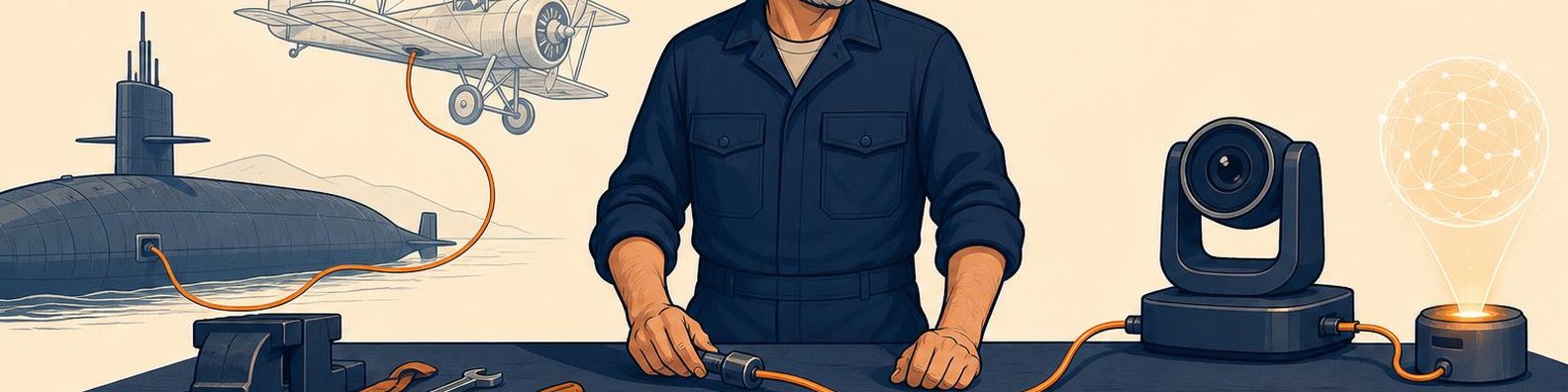
Machine-generated transcript; names and wording may contain errors. Recording setup and pre-interview conversation are omitted. Source timestamps may differ from the edited video.
Read the transcript
Simon J Dudley (00:00:01)
Welcome everyone, Simon Dudley. Welcome to the Before It Was Obvious podcast. Today, my guest is an old friend of mine, Dan Freeman. ⁓ hey Dan, it's great to see you. ⁓ we're gonna talk to one of the most I would say backroom influential characters in the A V space that I know, ⁓ and we're gonna hear quite a lot about a rather interesting story.
Dan (00:00:11)
Hey Shannon.
I was going to see.
Simon J Dudley (00:00:28)
So Dan, why don't you explain what you're doing right now, ⁓ professionally and where you are at the moment, and then we're gonna go back and start with origin stories and go from there.
Dan (00:00:34)
Okay.
Dan (00:00:40)
Alright, well that gets gonna be long and hairy anyway. ⁓ right now, ⁓ I'm still ⁓ V DO three sixty is still going concern doing really well on ⁓ particular verticals. ⁓ So rather than trying to come out with a shotgun and just saying, Everybody buy my stuff, ⁓ you know, I'm focusing on some very specific verticals and doing really well. ⁓ you know, some behind the scenes things.
Simon J Dudley (00:01:07)
Good.
Dan (00:01:10)
you say, you know, that's kinda where I live. ⁓ and I kinda like it that way. You know, I I can ⁓ I can get away with a lot more shenanigans ⁓ if I'm behind the scenes. So there you go.
Simon J Dudley (00:01:23)
Well I mean you're pretty famous for doing interesting things. ⁓ and I've always ⁓ I've always believed that you're one of the most interesting characters in the market 'cause you don't just say, I'm gonna do the the standard thing. I'm gonna do something different that's really interesting in a niche.
Dan (00:01:41)
Well, you know, ⁓ I I started years ago as a field engineer. So everything ⁓ that we do as a company in Video three sixty ⁓ starts with that thought. We don't we're not starting with the ⁓ what what ⁓ you know, no offense to the salespeople out there, none meant. Really none meant. ⁓ but it's not ⁓ salesperson derived product.
Probably to our dar detriment. You know, salespeople are really talented, they know what they're doing, but I don't think the field engineer gets enough credit. ⁓ And that's kind of where my focus has always been. I think if if you've known my products, ⁓ if you start thinking of them from that type of point of view, you realize just how strongly we've done that. It's yeah, it it's just my thing.
Simon J Dudley (00:02:36)
Well, that's fair enough. But let's let's get back. Let's start at the beginning. So where did you start life? Where did you go to school? How did how was your what was your early life like?
Dan (00:02:47)
Well yeah. Well I was ⁓ born and raised in the Pacific Northwest. Born in ⁓ town called Cordelaine, Idaho, which now is ⁓ like a big thing. But when I was born there, you know, hardly any people. ⁓ So ⁓ born there, raised in pretty much in the Portland area. grew up in Beaverton. I was ⁓ one of Nike's first employees. ⁓
When I was twelve I was cleaning up their warehouse on Saturdays free in exchange for a pair of shoes. And then I'd go sell the shoes ⁓ that week and that's how I made money. ⁓
Simon J Dudley (00:03:28)
That's what just to give us a sense of scale, what year are we talking about?
Dan (00:03:32)
Let's see, that would have been nineteen seventy one.
Simon J Dudley (00:03:36)
Right, right. So this is a while ago. Wow. Okay.
Dan (00:03:39)
Yeah, well yeah. Everything for me is a while ago, Simon. ⁓
Simon J Dudley (00:03:44)
Yeah, I know that feeling. ⁓ okay, so what about school?
Dan (00:03:48)
⁓ you know, got regular high school stuff. Interesting, you know, I had some ⁓ interesting classmate. ⁓ Jensen Wong and I went to the same school. We're classmates in high school. I wish I'd hung out with him more. ⁓ Evid ⁓ Evidently I did I'm kinda missed that boat. ⁓ joined the Navy, went in the the US Navy, ⁓ had first loaded bombs 'cause I thought that was kinda cool, but no.
⁓ then I started hunting submarines ⁓ and ⁓ became a P three air crewman and and part of that is, you know, ⁓ survival swimmer, you know, rescue swimmer. ⁓ did a lot of really cool stuff when I was in the Navy. I I enjoyed that a lot. I met my wife, which was the most important. Was that? ⁓ almost six years. Yeah. I got ⁓ got hit by a truck and then when they
Simon J Dudley (00:04:36)
long were you how long were you I'm sorry, how long do you serve for?
Simon J Dudley (00:04:44)
Okay.
Dan (00:04:47)
sewed my arm back together they kinda messed up that operation. So I wasn't able to fly anymore, so I moved on ⁓ and ⁓ moved came back up to the northwest for a little bit. Didn't really find my my groove. I went to school as a civil engineer and didn't really like that that much. ⁓ I was really good at doing drawings, but you know, ⁓ became a sign painter, believe it or not. I was ⁓
an artist for a while, so I you know, a commercial sign painter guy out there painting. ⁓ Computers came along and kind of ruined that whole industry. So I ⁓ kept doing that, went down to San Diego with my wife and ⁓ we lived there for a little while ⁓ and then moved out to Texas and ⁓ became a fiber optics lineman at the same time that I was ⁓ I went to some more schooling as an aircraft mechanic.
Yeah, I have a very diverse ⁓ background. So yeah.
Simon J Dudley (00:05:52)
Yeah, it's sh you certainly do. Okay, so I didn't know any of this. I suspect most of our audience won't. Okay, so this was a a fairly you know, series of turns. ⁓ and then you woke up
Dan (00:06:02)
It each one built on ch each one kept building on the next one, yeah.
Simon J Dudley (00:06:06)
Yeah, I guess that that's fair. ⁓ and then one day you woke up and said, I know, I'm gonna be an A V. How did that happen?
Dan (00:06:11)
⁓ Yeah, you know, ⁓ that's not quite the way it went, but okay. ⁓ it ⁓ get I was up here in the Seattle area. I moved moved back up here to be closer to the water. My wife and I are both, you know, avid sailors, so we wanted to be up up in this area. And it is gorgeous. I love it up here. ⁓
So at the time I was just doing ⁓ contract work and I was doing some cable TV installation stuff and went to this guy's house ⁓ and the the aircraft mechanic and me just about freaked out when I saw what the wiring looked like behind his ⁓ old stereo ⁓ entertainment system. ⁓ So I asked him if he would mind if I just straighten this up a little bit.
So I went to town, did my thing. I'm pretty famous back in the day of being Mr. Zip Tie. ⁓ And ⁓ you know e even afterwards, you know, people know me as that. ⁓ so ⁓ I put everything together and the guy asked me for a resume and I thought it was so cool because I had a you know, little little floppy of my resume, handed it to him. ⁓ You know, free PDF stuff.
And ⁓ I thought, yeah, yeah, yeah, yeah, I'm pretty up to date. ⁓ So ⁓ in the meantime, I I came up here planning on going to work for Boeing as a as a line mechanic, which is a really good job ⁓ as an as an AMP up in this area. ⁓ The same day I got a job offer from Boeing to go up and start being a line mechanic, you know, a thing that I worked towards. I got this job offer from this little company
⁓ to do video conferencing. They liked my resume, they liked the interview I did with them, ⁓ and ⁓ they wanted me to do ⁓ see if I can be a field engineer doing video conferencing. ⁓ Company was T Line Services. ⁓ And that was God thirty years ago. ⁓ yeah it was a while. It's been a while. ⁓ so T Line ended up
Simon J Dudley (00:08:20)
What year are we talking?
Dan (00:08:32)
becoming ⁓ VSGO. So we all know VSGL. ⁓ And that's the roots of that company was T Line. And you know it's kind of cool that the field engineers at T Line were the best in the market. ⁓ and I was lucky to be brought up in that same group and trained up. I've done some really adventurous
things in the installation world, you know, I got you know might get parachuted in all these places 'cause I guess I was the ⁓ the ISDN whisperer and I could f figure figure this stuff out. And I knew a lot about programming ⁓ you know different types of ground stations and satellite modes and microwave stuff. Just all kinds of ⁓ weird stuff that for some reason I was able to do.
Simon J Dudley (00:09:12)
Yeah.
Simon J Dudley (00:09:29)
Now for for our audience, I better give this is like what ninety-five, ninety-six type era. So for the audience who's younger than fifty, ⁓ I I better explain ISDN. ⁓ it stands for stands for something no, I thought it still it still does nothing. ⁓ was the and it got ultimately replaced by ISDS. It sort of does something. So ISDN was digital telephone lines.
Dan (00:09:29)
And ⁓ yeah, quit.
Dan (00:09:34)
Yeah, yeah.
Dan (00:09:44)
yeah, I still don't know.
Dan (00:09:50)
Yeah, that's that's that's right. That's right.
Simon J Dudley (00:09:59)
you would connect multiple of those together ⁓ to ⁓ yes and you would have ⁓ a whole bunch of these lines normally six for a high quality call you could really go crazy and have eight ⁓ and it was ⁓ you could do a a video call at three eight four or five twelve K. 512 very rare three eight four was pretty standard. ⁓ the only problem was you were paying six times the standard phone call charge. So if you were
Dan (00:10:02)
Multiplexing, yes.
Simon J Dudley (00:10:27)
making an international call, it was six times the international call rate, which was outrageously expensive at the time. So I'm gonna assume it was either Pigatel or V Tel, because they were the major players in the market at that time. Did you do both or one of those?
Dan (00:10:44)
Yeah, I've done both. ⁓ it was mostly Picture Tell. Yeah, and then ⁓ then of course, you know, the transition. I was there during the transition when ⁓ via video came onto the market and Craig Malloy and Paul all that. ⁓ actually installed the ⁓ first ⁓ two hundred systems that went into Microsoft. And there were the
Simon J Dudley (00:11:09)
Right. And the the again for the audience, via video became Polycom's video division, Craig Malloy ran it, and those products would have been the View Station, which revolutionized the market in ninety nine and two thousand.
Dan (00:11:18)
view station. Exactly. Yeah. ⁓ Yeah, and then then ⁓ because of my background ⁓ when I was a fiber optics guy, I was ⁓ on the team that developed the cable modem out of ⁓ Colorado. So I worked with cable labs there. And so ⁓ kind of you know ⁓ kind of was dipping my toe in that world. ⁓ and ⁓
So then they started using me a T line for doing ⁓ some pretty oddball installations. One ⁓ was that they flew me to Moscow, Russia. I did ⁓ Rosneft, ⁓ the the oil company. That was an experience. ⁓ was there for almost a month. I did everything from programming all the satellite ground stations. ⁓ This is the first first time that it
they'd been attempted to do full satellite IP video. ⁓ So ⁓ did all the ground stations, did all their Cisco racks, ⁓ and then did the rooms ⁓ and then ⁓ built out the the ⁓ main boardroom, did all the custom audio and you know built the D S P around that and ⁓ what a lot of ⁓ stuff. It was pretty funny though when I arrived in Moscow
Simon J Dudley (00:12:21)
Right.
Dan (00:12:45)
I had a duffel bag full of tools ⁓ and then ⁓ parts and fasteners and just all kinds of things. I had no idea what I was gonna be able to get while I was there. And it's a good thing I had those things. ⁓ the the ⁓ the guys that were expecting me there, ⁓ the ⁓ the IT group from Rosnev now and they were all at the time they were all Ukrainian.
Because ⁓ Ukraine ran basically all the all the IT for the Russians. ⁓ I arrived and they were looking around for the rest of the crew. ⁓ Like we're supposed to have a bunch of different people doing all these different things. ⁓ And you know, in our world, you know, one tech is supposed to be able to do all that. But in their world, every tech did everything. And I'm not saying they were good.
Simon J Dudley (00:13:37)
Yes.
Dan (00:13:43)
They were absolutely brilliant at what they did. But they only did one thing.
Simon J Dudley (00:13:49)
Now out of interest, at that time, right, you so you were I think you're the first guest I've had on who actually went through the ISDN to ⁓ IP transition, right? ⁓ did you see it coming?
Dan (00:14:03)
Well, you know, when we were starting to play around with H three twenty three, yeah. ⁓ And when that was happening, ⁓ it was right at the the DOCOM bus too, ⁓ when everything was kind of crashing out. ⁓ And I went ⁓ I went independent from T line at that point and started ⁓ company with Peter Zalum was called VCAV. ⁓ And we were the pros from Dover. We would do the polycon.
We would do the picture tell when they were still around. We'd do ⁓ the Cisco, we would do the Life Size, we'd do the video. ⁓ All these different companies ⁓ would hire my company, VCAV, because they're all a bunch of techs like me that, you know, basically we just put a different hat on a go. We'll go do our job. ⁓ I've probably done close personally like 3,000 installs. So I've been in a lot of conference rooms.
And seeing that transition from ISDN to IP, you know, 323, H two sixty five stuff, da da da all that, ⁓ and then the transition to the soft coding. ⁓ I've watched ⁓ these different disruptions in the industry and tried to stay kind of ahead. You know, it's watch watching watching how these things are kind of breaking and and not fitting in with what the market's gonna want.
and try stay ahead. So from ISDN to IP I saw th ⁓ well for one thing I didn't even know how to program a five E switch anymore. Which that was great. I didn't have to do that because I hate doing that. ⁓ then they had that same transition though when we saw the the hard codec going the way of the soft codec, we also saw the installation processes change at that time too.
So we went from a hardware centric model to a software centric model, and now we're kind of the software centric guys are saying, well, we're not making you know any money on software, we've got to do hardware too. ⁓ So there there's a lot of interesting things that I'm seeing happening in our industry right now. And that's one of the reasons I'm just focusing on doing a couple of different product lines, is just because I see I see too much disruption going.
Dan (00:16:29)
It's time to kind of time to just kind of hold hold on my pants and keep them out of the water.
Simon J Dudley (00:16:36)
It it's fair enough. I mean so the the podcast is after all called Before It Was Obvious, right? I say this in other events I've done as well recently, that looking backwards in history is relatively easy and everything looks obvious and it looked like it was pre-planned and it was never pre-planned. We all just made it up as we went along and anyone who says you otherwise, I I don't believe them ultimately. ⁓ so what did you
Dan (00:16:56)
Kill do?
Simon J Dudley (00:17:02)
Was there a particular technology or event or thing that you can think of and you went, I completely missed that. It it blindsided me completely.
Dan (00:17:12)
⁓ yeah, that that the amount of ⁓ influence that marketing would have ⁓ on the hardware. ⁓ And you know, yeah, I think you've read probably stuff that I've written before about when good enough isn't. Because it isn't. Because if it was good enough we'd still be doing ⁓
You know, I understand that's good enough. ⁓ we keep Yeah, yeah. Yeah, it it's fine, it's good enough. It's still crap, it's all right. ⁓ then d it's I find that to be the the one ⁓ the rock that I'm rolling uphill all the time. Is the the good enough thing. ⁓ And I think that that ⁓ is ⁓
Simon J Dudley (00:17:44)
Or telephone calls. I mean a telephone call hasn't changed in quality in a hundred and twenty years.
Dan (00:18:11)
What I found interesting and and frankly disappointing is that that people move past technical excellence ⁓ to ⁓ something that's that does the function.
Simon J Dudley (00:18:28)
Interesting.
Dan (00:18:28)
You know, I I've always taken pride on you know, ⁓ I'm a I told you I'm a air aircraft mechanic. I'm I'm a mechanic, and I'm a good mechanic. ⁓ And I have a ⁓ you know, a custom you know, classic car that I'm constantly just trying to make a little bit better all the time. You know. ⁓
finished it looks as a project card. And I think that ⁓ we've missed we've missed out on that ⁓ pride, I guess, ⁓ yeah, of doing that dic extremely good work.
Simon J Dudley (00:19:15)
Yeah, I I think it's an interesting position in the market that we we live in a world where ⁓ most technology is not optional. Right? If I was coming to work for you or potentially coming to work for you, and you said, Have you got any further questions or things I need to know during the interview? If I turn around to you and said, well, just so you know, I don't use Microsoft products ⁓ or I don't use ⁓ email ⁓ or
I I'm I'm not a fan of the t telephone, so you know, I I won't be using the telephone. You probably wouldn't employ me. But video has always remained an entirely yeah, entirely optional technology.
Dan (00:19:53)
Turn off that camera. People turn off the camera.
Dan (00:19:59)
Actually, you know what though? ⁓ If if I'm being called into a meeting, and I always use my camera, ⁓ if I'm being called into a meeting ⁓ and I notice that the other people are not, I call them out on it. ⁓ And ⁓ that if it continues on, I just tell them I'll join them at another time when they're willing to put turn the cameras on. Because if I'm not doing a phone call with somebody, I'm doing a video call.
I want to see what they look like. I want to see what kind of effect my words are having with them. And I can can't really tell that when somebody's being quiet on the other end of the phone.
Simon J Dudley (00:20:41)
Well, that's the whole point in video, isn't it? It it we we live in that strange ⁓ world where it's better than a phone call, but people at least traditionally haven't treated it as good as a physical meeting. So ⁓ I rem I mean I've spent thirty years with every new marketing director I've ever met in the video conferencing space saying, Wow, all we have to do is convince our customers not to use ⁓ the f the plane to fly to Paris for that quarterly meeting and we could pay for video and it's like, yeah but
They like going to Paris on a quarterly ⁓ event. It's that ⁓ I got him a ⁓ it's the three PM on a Wednesday afternoon in Cleveland call that you want to get rid of. But by the way, I I d I must tell ya
Dan (00:21:12)
⁓ That's not what you want to get rid of. That's not the trip you want to get rid
Dan (00:21:22)
Yeah, yeah. If you're gonna go into Fort Lane, Indiana, let's let's let's talk about that, right?
Simon J Dudley (00:21:28)
Well, Cleveland, I got I got in trouble once 'cause I said that at a conference and found out the entire audience was from Cleveland and they they they all ⁓ they all booed at me and I'd never been to Cleveland and when I went back the next year to give another talk to the same group I said actually I've been and it and it was absolutely lovely and discovered that actually I hadn't been to Cleveland, I'd been to Pittsburgh. ⁓ And they hated me even more for that. But you know, what can you do? I'm a foreigner.
Dan (00:21:42)
I see all yeah.
Dan (00:21:55)
Well it's not it's not Paris, Simon. There you know, there there is that. ⁓ Yeah, yeah. It really is. It yeah. ⁓ I get it.
Simon J Dudley (00:21:58)
N It's the p it's the Paris of the Rust Belt.
Simon J Dudley (00:22:04)
So so we you you you brought us up to about two thousand and five in in the latest telling, right? You know, you you moved to the IP world, then and then you were running your own ⁓ your installation c ⁓ company.
Dan (00:22:12)
Yeah, pretty much. Yeah. ⁓ Yeah.
Dan (00:22:19)
Yeah, had had a had a group VCAV and Peter's still running it, I I believe. ⁓ you know, and it was it was cool. Well we saw the transition definitely from the trenches. ⁓ We saw people not buying those room systems that we were installing and getting paid good money to do. But but ⁓ doing a lot more of the little desktop camera, weird little camera things that were going on.
PCs ⁓ and you know it's starting to ⁓ try to figure out with how to use some of this new software codec stuff. So
That transition happened ⁓ hard, you know, about ⁓ what was it, twenty twelve, twenty eleven, twenty twelve. ⁓ I was ⁓ on my boat at that time, I'd already started ⁓ Video three sixty. ⁓ sailed from s yeah, another thing I do is I'm a sailor, right? So sailed from Seattle down to I was in Mexico, down to La Paz, ⁓ and just, you know, that was
Going out and doing some pretty cool projects still. ⁓ I had one where we had all the all the Forest Service ⁓ Ranger stations. And it was the one ⁓ and I that I I know they got that project because of one thing that I did personally. When I had my VCAV company, I was called ⁓ called in to drive across ⁓ the state of Washington, I was living over here.
state of Washington to ⁓ Missoula, Montana. It was a blizzard going on. And there's such such a blizzard that even in Montana they weren't flying out of the airport. ⁓ And that forester that was in Missoula was being sworn in as the new US forester. So the head of the Forest Forestry Department, US Forest Service. And as a female.
Dan (00:24:26)
first time female too. So this is a big deal. ⁓ And so they reached out and said, Hey, we need you to go install the video conferencing system in Missoula so they can do the swearing in ceremony and this thing. But you do know what's going on right now, right? This is on a Sunday morning. ⁓ And I said, Yeah, yeah I guess you're having some weather out there. I said, You have no idea. ⁓ Which so normally a trip from where I live to Missoula would be ⁓ six and a half hours.
it took me twenty. ⁓ And ⁓ it was ⁓ really, really hard to get there. I get there, ⁓ I set up the system, did the ISDN magic, which was, you know, that that magic and got this system going. She got sworn in and she turned around and she goes, All of our offices are getting these. This is amazing. This is the gaboon. So was it two, three years later?
three years later I think, ⁓ my company VCAV, we got the contract for ⁓ all the Forest Service offices. ⁓ Not the sales, ⁓ but the installations, because ⁓ the head of the Forest Service says my company gets installed. ⁓ So ⁓ all right, cool. ⁓ So that was great. It was that was wonderful, wonderful job. Traveling all over. I was on my boat, I'd come up and hop and, you know, and drive round and
Simon J Dudley (00:25:46)
Twenty hours well spent.
Dan (00:25:55)
These cool places and I mean seriously some beautiful, beautiful places. And then Washington D C too, so the other end of the spectrum. ⁓
So I'm seeing this ⁓ all happening and so I decided I'm gonna go ahead and sell off half my business to Peter, my half, and then I would start this new company, V DO three sixty. So I did that, ⁓ because I wanted to 'cause I realized that nobody was making good equipment and especially you know, these the poor field engineers are having to try to figure out how to make these rooms work. You know, we
We show up as a field engineer, you show up, there's a pile of boxes on the table and wonder how I'm gonna put all this together. Yeah. ⁓ We we you know, most of the time we really didn't have a lot of drawings to go with. ⁓ so I started V DO three sixty and ⁓ worked with my current partner in China, ⁓ Alex, and we created the first Pantil Zoom USB camera. So it was the
Yeah, Badio had their ES Easy USB product, but it's basically a USB conversion on the bottom of the camera, not a right right from the sensor. So we did that. ⁓ built a few other things. I think you know you've seen some of The the PTZ PC, first time anybody put a PC inside of a ⁓ P T Z camera. That was kinda cool. I like that's actually one of my favorites. ⁓
Simon J Dudley (00:27:37)
⁓ What?
Dan (00:27:38)
It I just love it. I have it sitting up here on my desk so
Simon J Dudley (00:27:41)
What year did that come out?
Dan (00:27:43)
⁓ shit, when was that? Twenty fourteen, fifteen, something like that. Pretty early. Pretty early. ⁓ yeah, that's pretty cool. It's got an Intel I five in it and worked with the guys at Intel. That's where I met ⁓ Brian Cockrell from ⁓ Intel Unite. And Brian was trying to get the guys at Intel to understand just how powerful having a PC in the conference room would be.
So Intel worked with me on that and yeah, I did a lot of interesting things ⁓ along that line with Intel. And Brian and I have become very good friends. ⁓ Actually Brian and I are working on a my new project, ⁓ AR time travel or RD dot AI. So I've got a AI program I'm working on too. So I do I'm doing a couple of a few things. So
Simon J Dudley (00:28:38)
Well, so let's talk about that in a bit of detail. So what is this new project? ⁓ by the way, before we started this recording, Dan did say to me, Hey, you have read the book and I went, Mm, I haven't read the book. I haven't done my homework, the s the the I should have read it on the bus or something. I'm not very good at doing the homework. So I apologize for not doing the homework. So l we you, me and the audience will all learn about this at the same time.
Dan (00:28:49)
Mm-hmm.
Dan (00:28:56)
No, that's all right. It's all right.
Dan (00:29:01)
Good. So
There's few few things unpacked. So I took my mom to Rome. To my mom had never been to Rome. ⁓ I was lucky I've been a few times and got to go through the forum and walking around the Roman forum, private guide, you know, just my wife and I, my mom ⁓ and this private guy. Walking around and very good guide too. ⁓ Professor at the local university, everything, just ⁓ new newer stuff.
In and out, and was explaining about different things. And I I don't know if you've ever been to the Roman Forum, but where Julius Caesar's tomb is, is literally a pile of rocks. ⁓ There's nothing more than it's a pile of rocks in there. And that's the tomb of Julius Caesar, ar inarguably, probably the most famous Roman of all. Yeah, everybody knows who Julius Caesar is. ⁓
So I'm s we're standing there and I'm visualizing, I can see, you know, what this was ⁓ and why it ⁓ looked the way it does. ⁓ And my mom's like, I don't get it. I don't see it. So at the time, ⁓ it's it was very early in the augmented reality world. But I'm thinking, gosh, you know, a pair of glasses I could put on ⁓ and it would have the guide inside the temples, the
classes telling me what's going on and then I could have an overlay and show that show me what the site looked like. ⁓ you know two thousand years ago, you know, eight hundred years ago, whatever. ⁓ and that was my idea. ⁓ So came back from that trip ⁓ and started looking into that and ⁓ worked with a few people I know and then Brian was ⁓ the Intel closed off their client computing.
Dan (00:31:04)
And Brian reached out and said, Hey, if you're ever doing anything interesting, I said, as a matter of fact, this is one thing that I want to try. And he's like, that sounds weird. Okay. ⁓ so ⁓ so we started putting together, you know, an idea of ⁓ doing this these classes. ⁓ Well the glasses just aren't ready yet. But what we have done is we've created the platform that was supporting. ⁓ And
That's actually much more difficult than you would think. Because we've got a l there's a lot of pressures ⁓ on that product, you know. you know, obviously it's got to be something that's gonna be AI driven because it's has to know what you're looking at, what the context is ⁓ and ⁓ you know what your biases are, what the things that you're interested in. So, you know, if you have a
bias towards the you know the personal side of things, the AI would know that. If you have an I ⁓ bias towards mechanical the the AI would know that. And so it'll feed me the the information that I want out of not out of the cloud data, but out of actual rag data, out of out of vetted curated data parcels, pockets as we call them.
that you drop the the data into and the AI can only go there. It doesn't know anything outside of that. It knows everything about what's inside that pocket. But and it can talk to you. And we've got the response time down now to ⁓ four hundred and eighty milliseconds. So it's like
Simon J Dudley (00:32:52)
Which makes it at that pace it's basically human speed. Yeah.
Dan (00:32:55)
Converse it's conversing. Yeah, it it converses with you. ⁓ that was pretty difficult to do. We're doing it all on device because if you're in the catacombs, you know, these AI guides that they're doing today don't work. ⁓ the other part of that is the AI guides that are mostly in use today are not rag based. They're ⁓ they're like web based. So you're gonna go out
Simon J Dudley (00:33:09)
Yeah.
Dan (00:33:25)
And get all the information that's out on the World Wide Web. That's not necessarily true information. And that's it hasn't been vetted. ⁓ You may get hallucination. There's one company out there, I'm not going to state who they are, but one of their claims to fame is they're 80% accurate.
Simon J Dudley (00:33:45)
a whole eighty percent. That sounds completely reasonable.
Dan (00:33:46)
Yeah, yeah, eight eighty percent accurate. ⁓ I ⁓ I about choked when I read that. I went, ⁓ wow, that's something to brag about. ⁓ so we started this company AR Time Travel. ⁓ We also have the the websites ⁓ of so this this AI has to have a name. So ⁓ AR Time Travel, A R T T Y ⁓ R D.
So Artie is our AI. ⁓ And if you go to ARTTY.ai, that's our website. And actually we have ⁓ a ⁓ a slow and stupid version of Artie ⁓ on the on the webpage that you can interact with and see that if there's if the information is not there, Artie ain't making it up. It's ⁓ he'll just say, I don't know. I don't have that information.
And I think that's more valuable than just trying to answer every question. Just
Simon J Dudley (00:34:52)
Well, I think also the the ⁓ the generalist stuff has already been done, hasn't it? There's plenty of players in that space. ⁓ and you take your life in your hands as to whether how accurate it is. It's it's strange, isn't it, that most AI ⁓ is ⁓ useful to you if you're already a subject matter expert, because you could tell if it's hallucinating. But if you if you don't know the topic well, then how do you know what's hallucinations, what what's not?
Dan (00:35:12)
Yeah, exactly.
Dan (00:35:17)
You know, and if and if you own that ⁓ site or or museum or you ⁓ know, frankly this works in smart cities and stadiums and there's all different kinds of verticals ⁓ that this particular ⁓ type of AI can work in. If you own those facilities, hallucination is like your biggest fear. If if if that site is subject to hallucination, ⁓ that
Could you know in a in a ⁓ large stadium, that could lead to somebody getting hurt. ⁓ you know, imagine you have the the emergency exit thing comes up and RD saying, okay, go down here, turn the left, go down these stairs, and you're outside the door. Well, if ⁓ RD didn't know that information for sure, and was only 80% positive that that's gonna may say,
Go down those stairs and you know kind of look around and maybe run out that way. ⁓ that's not going to help you and that could actually hurt. So we feel that ⁓ our approach to especially doing it on device, ⁓ so we have that rapid response, there's no hesitation. There's ten thousand people using this application at the same time, doesn't matter. It's ten thousand individual operations.
Rather than trying to go to the same service.
Simon J Dudley (00:36:49)
So this is interesting. So you you fell into the A V space and you're I don't know, would you treat this as a as continuing to be A V, or is this are you moving out of A V into a different world, or do you not really think about it in those terms?
Dan (00:37:00)
Well, I never really was in the A V space, I was a tech.
Simon J Dudley (00:37:06)
Yeah, fair enough. I mean it's all semantics, I suppose, ultimately. It's how we're w
Dan (00:37:08)
Yeah, I'm a I'm a and you know if you go back far enough, I'm a mechanic, Simon. That's what I do. I'm a mechanic. ⁓ I just happen to work on a really small things ⁓ and ⁓ try to fit that really small thing into people's lives.
Simon J Dudley (00:37:14)
Yeah, yeah.
Simon J Dudley (00:37:25)
Well, and that's actually one of the things that's always interested me about what you've you've done with your career. It's always been about I I never got the sense that you've wanted you you not you didn't chase the commercial angle, you chased the interesting angle. And if it made you some money, well that was great. But but that was always secondary. Plenty of other people in the industry are not like that, which, you know, e each person has their own agenda. Y yours is definitely on the engineering purity side.
Dan (00:37:45)
Yeah, it's always
Dan (00:37:50)
Sure. ⁓
Dan (00:37:54)
Yeah, and I'm I I would I'd like to think that I'm trying to do ⁓ the right thing. ⁓ I'm not a greedy guy. ⁓ I'm just not. And ⁓ yeah, I've I've got plenty of make me happy and you know could I use more? yeah. ⁓ But ⁓ not anymore. I had to sell the boat. So it's yeah. It's too far away. Yeah, ⁓ bigger bigger than that one behind.
Simon J Dudley (00:38:14)
Well, you've got a boat, so clearly ⁓ All right. Well but I'm guessing you'd like another boat. So it as soon as you say boats are aircraft then then everything costs a fortune.
Dan (00:38:26)
Yeah, yeah, that's it. ⁓ And then ⁓ then this kind of led to you know, my I started about two, three years ago. I started an exercise where I'd ⁓ wake up in the morning and write a thousand words. Don't care what it was about, just gonna sit down and write a thousand words. ⁓ Kinda fun. That was that was a fun thing, fun exercise to do. ⁓ And then I started streaming the day to day.
into ⁓ a script ⁓ and and I noticed a holy crap, boy, over a period of a couple months I may be way off from where I started. ⁓ And that's pretty fun. I mean that's a again that's ⁓ an exercise in seeing seeing where your head's at, right? ⁓ then then it was it about about a year ago I I was working with Brian and we're working on this AI stuff and
So much ⁓ yeah, there's so much AI talk going around ⁓ and I I thought about ⁓ AGI. How are we going ⁓ how are we going to treat AGI when it arrives? ⁓ The singularity? How how are we gonna react to it? Are we going to treat those AGIs as ⁓ created consciousness as as like a child or are we gonna treat it as a tool?
⁓ And ⁓ frankly, I think if we create a consciousness, it's our responsibility to teach that consciousness ⁓ morality. ⁓ And it bit it's in ⁓ endemic on the creator, whether it's a parent ⁓ with a child ⁓ or an engineer with a GI. It's going to be endemic on the creators of that to create a moral standing in that AI.
So I wrote a series of books. So at the time there was ⁓ the ⁓ extra galactic comet thing that came through here called Three Eye Atlas. ⁓ And I thought, okay, well I'm a big believer in physics, but I love science fiction too. ⁓ And so ⁓ you know, in science fiction movies you got, you know, ⁓ warp speed captain, which is bullshit. ⁓
Simon J Dudley (00:40:41)
Mm.
Dan (00:40:57)
⁓ but really the way that we're gonna travel through these ⁓ immense dis distances. ⁓ We're not gonna fold space, we're not gonna it just doesn't ⁓ the physics just doesn't align up. ⁓ not yet, you know. We always learn something new. ⁓ But today, from what I know, ⁓ and that little reading. No. So how are we going to
explore. What are how are we gonna cast out who we are as humans ⁓ to these vast distances that take thousands of years to travel? Well, we do it by creating an AI and sending out our AI. And that's because you know that no organic thing is gonna live that long. So that's what that book's about. That ⁓
Simon J Dudley (00:41:43)
Yeah.
Dan (00:41:53)
Atlas was the one in the series of visitors that have coming by the planet, checking stuff out, seeing if we're ready to move. And then the middle there's it's a triptych. It's like three novellas. ⁓ You know, it's too long to have as one book. ⁓ then but anyway. So the the middle one in the book is about ⁓ how they created a distributed AI, because that's what I'm doing.
So we're creating a distributed AI and it becomes conscious because all the individual nodes ⁓ where any individual any node drops off, it's just like losing a brain cell, and I think we've all killed a few of those. So ⁓ that's the middle part of the book. And the end part of the book is we've created this AGI. How do we treat it? Do we treat it with respect as we would another consciousness?
So that was that book. Kinda heavy stuff, but still science fiction and fun. And yeah, that's kind of the type of writing I like doing.
Simon J Dudley (00:43:01)
So it's an interest I I what wasn't aware we were going to end up talking about AGI today, which is actually one of the reasons I've done the podcast, is because I knew conversations would go in all sorts of directions. One of the questions I have, or or thoughts I've had, and I've written about this myself a little bit, is the trouble with things like the word AGI ⁓ is ⁓ and consciousness is we don't actually understand what consciousness is in a human. So how can we define what it is in a in a
in a machine. ⁓ it's one of those really open and i another example would be the word intelligence, right? You you have the word intel we don't know what intelligence means. Is is it your ability to s solve business ⁓ you know
Dan (00:43:42)
No, I I I agree. ⁓ But you know, I if you circle back on that though, we don't even know what artificial means. Because just can't if you really want to play it. The machine is a real thing. It's not artificial.
Simon J Dudley (00:44:03)
Yeah, so we don't know what artificial, we don't know what intelligence is, and we don't know well consciousness. So, you know, i I think it's a little bit like the whole evolution conversation. The problem with evolution is it uses words like design. And nothing in evolution is designed, because design implies a designer, and evolution doesn't have a designer. But we don't have better words. And I think that computer science and the whole
Dan (00:44:09)
Consciousness. ⁓
Simon J Dudley (00:44:33)
artificial intelligence world needs new words. It it uses words like
Dan (00:44:37)
I I I'm I'm not a fan of the term AI. I'm just not a fan of it. Because like what we're doing is not actually an intelligence. ⁓ It's a really, really, really good interpreter of of the product. Yeah, it's that's that's all I'm doing is a built-a filter. ⁓ Yeah, that's really all it is.
Simon J Dudley (00:44:42)
Well it it's become you
Simon J Dudley (00:45:01)
But you could argue that human consciousness is just a is it's the same thing. Your subconscious makes all the decisions and then your your conscious mind simply rationalize the decisions you you've already made. In fact there's quite a lot of evidence to suggest that that is true. ⁓
Dan (00:45:04)
Same thing.
Dan (00:45:16)
Yeah, and then then you know, we're talking about cameras. I've had this discussion on on cameras. My blue is not the same as your blue.
My green is not the same as your green. ⁓ No matter if we agree that that's green or we agree that that's blue, we've made the conscious decision to agree to that.
It's not that when we define those colors, everybody's eyes see things differently. And if then that's when we go and we build cameras ⁓ and I've been yeah, I'm really picky about my camera. Obviously, yeah. Pretty good cameras. ⁓ it's because we get the widest consensus on what the product is supposed to look like. What what those colours are
actually how they're working. ⁓ That's ⁓ the same thing that we have. The imp imprecise nature of language is the same issue as what you're saying.
Simon J Dudley (00:46:20)
Well, it's also an imprecise example of what perception is, too, because everyone's perception is different. What I see as blue and you see as blue, in our mind, might not be the same thing anyway. ⁓ In fact, there's probably quite strong evidence to suggest that is true, or else we would all enjoy the same sort of art, for example, and we don't. ⁓ so so for example
Dan (00:46:30)
Yeah. Yeah.
Dan (00:46:41)
Exactly right.
Simon J Dudley (00:46:45)
Where do you go with this in the next what's your plan for the next five years or so? Have you got a this is the angle I want to go down? Or are you ⁓ open to whatever happens next? Because the world seems to be changing at such a rate now.
Dan (00:46:58)
I you know, if you if you s five years is like ⁓ saying twenty five years. ⁓ You know you know, we're and when we were parting like it was nineteen ninety nine, where are you gonna be in the year twenty twenty five? You know, ⁓ now it's gonna be where are you gonna be in twenty thirty?
I think that we're in for ⁓
Dan (00:47:26)
a rapid upheaval in technologies. ⁓ And it's ⁓ going to be because people actually get used to using these ⁓ LLMs and SLMs for the right reasons and not just cheating on their exams. ⁓ When they're s when we start using them for ⁓ creating new and novel ⁓ chemical compounds, for instance.
⁓ Or creating that ⁓ that that cure for cancer that I can do a million runs on in an afternoon. ⁓ It's just it's so fantastic. And we're gonna see some negative stuff from that too. We're gonna see people you beyond bad actors using it. But I think on the whole, I think it's gonna be very, very, very good for mankind to have a good tool. ⁓ And we just have to remember
Simon J Dudley (00:48:04)
Yeah, with all the protein folding and other stuff.
Dan (00:48:26)
that ⁓ LLMs ⁓ and SLMs and you know these these ⁓ models that we're using now ⁓ are ⁓ only tools. They're not AI. They're not ⁓ intelligence in any way, shape or form. They're a a compendium of intelligence.
Simon J Dudley (00:48:48)
Well and they're they're ultimately an extremely sophisticated pattern recognition machine. Which which which but maybe that's all we are. Maybe
Dan (00:48:52)
Exact. Sorry, that's all.
Dan (00:48:58)
Well that's it. Yeah, really. Yeah. Yeah.
Simon J Dudley (00:49:01)
And that I personally I'm fine with that, but but anyone with a religious bent is gonna maybe struggle with that. It it ⁓ you end up running out of reasons for meaning of life, for example.
Dan (00:49:08)
can I read them?
E even that even those folks and and I'm not, but ⁓ you know, I have to try to understand where they would be coming from in this this whole situation. ⁓ And again it ⁓ goes back to, you know, what's your definitions of this, definition of that, ⁓ you know, our our definition of blue, right? It ⁓ exactly. ⁓ what do you feel it is?
Simon J Dudley (00:49:36)
or intelligence.
Dan (00:49:41)
⁓ If you feel that we've created something ⁓ that's ⁓ an abomination, then you feel that way. But ⁓ most people are not that afraid. I mean, I don't think most people are that afraid. I hope not.
Simon J Dudley (00:49:57)
No, but it it could be the other way around though. You could end up with a with a an AGI, which or let's use that word, right, without really defining what that word is, a thing that appears intelligent, a a ⁓ a something, an entity that passes the Turing test, ⁓ and ⁓ it it seems to exist, it seems to be alive for want of a better turn of phrase, it seems to be intelligent. So if you switch it off.
I is that murder?
Dan (00:50:30)
Exactly. Exactly.
Simon J Dudley (00:50:31)
Or if not murder, maybe murder's the wrong way, but or but is that an ethically unreasonable thing to do? I ev dunno. ⁓
Dan (00:50:41)
Yeah, yeah, okay. I I'm of the opinion that when we get to that point to where it's indistinguishable from your neighbor next door.
That yeah, if I was to turn off my neighbor next door, that would be murder. And I like my neighbor, he's a nice guy. But ⁓ but if I was to turn turn him off, you know.
Simon J Dudley (00:51:00)
Ha ha.
Well that's I'm pleased your neighbor I think your neighbor's gonna be very pleased to hear that. Yeah.
Dan (00:51:07)
Yeah, yeah, well yeah, th they they know me. They're all right. They all they already think I'm pretty weird. ⁓ yeah, I I do think when we do get to the point to where it's indis indistinguishable, that's when we really need to make some substantial ⁓ changes in how we think of consciousness.
can you know the and and I'm not prepared to make any decisions on it. And I'm not that I'm not that person. ⁓
Simon J Dudley (00:51:34)
Okay.
Simon J Dudley (00:51:38)
it's an it it's an ethical question, isn't it? I don't think I'm qualified either for ethical questions. So ⁓ changing gears a little bit.
Dan (00:51:45)
I can only make I can only make the decision that I'm gonna make and I'm gonna always be nice to my robot overlords.
Simon J Dudley (00:51:52)
There you go. Always say please and thank you in the LLMs because they'll be in charge at some point. So ⁓ so question I've asked everyone so far on the podcast, and I'll do it with you, is if you were 18 today, what would you do? What would ⁓ what would be or what would your advice be to the eighteen year old if you are eighteen today? ⁓ And travel?
Dan (00:51:55)
Yep, yep. I don't care if it takes tokens or not.
Dan (00:52:17)
Go travel. Travel. Travel, travel, travel.
Simon J Dudley (00:52:23)
Gimme why?
Dan (00:52:24)
go be uncomfortable. Live in chaos. Cha's outside your comfort zone. Learn to be flexible. Learn to take a hit.
Simon J Dudley (00:52:32)
D does that mean not go to college?
Dan (00:52:37)
If that's what your path is, then don't.
Simon J Dudley (00:52:40)
Do you think that ⁓ you think that travelling would be better than going to college at this juncture?
Dan (00:52:46)
Travelling's the best education you can ever have.
Simon J Dudley (00:52:50)
I I must say I would tend to agree and it's exactly what I did. ⁓ what about if you're thirty?
Dan (00:52:58)
That's when you start thinking about, okay, I've been traveling for twenty years or fi ten years, fifteen years, whatever. ⁓ what have I learned ⁓ and what's needed in my world? How can I how can I take care of a need? And that's what I'd be addressing next, yeah.
Simon J Dudley (00:53:20)
Interesting.
Dan (00:53:22)
In your forties, like okay, time to think of going on screwing around for a little while. I did. ⁓ you know, hop on your boat and go travel some more. And then in your fifties get back here and get to work. I tell you what, today I'm God, I'm not in my fifties anymore and I'm nearing this you know, the end of the sixties. ⁓ I could not be more creative. ⁓ I am at my utmost
most powerful entity right today. And I just finished another book. This one's not it hasn't been released yet. The first one, you wanna go to Amazon, gonna pitch, go to Amazon.
Simon J Dudley (00:54:03)
We'll we'll put all the links to all the books in the description for the YouTube.
Dan (00:54:07)
Okay. But yeah, the first one is the Atlas Protocol and it's a three book series by the D. E. Freeman. 'Cause I figured, you know, why not have a a pen name that I can remember? So it's like my first middle initials and my last name. ⁓ yeah, really difficult. ⁓ And then ⁓ the the book I just finished, it's not published yet. ⁓ I think it's probably the best thing that I've ever written, and I've written a lot. It's
Simon J Dudley (00:54:17)
A non deplume?
Dan (00:54:37)
spectacularly good. ⁓ called Icon Agua. ⁓ And I woke up from a dream. ⁓ I've I've been one of those lucid dreamers. So woke up, wrote it down, went back to sleep. And that's what I was working on.
Simon J Dudley (00:54:54)
So why why do you think in your sixties you've become more more ⁓ productive than ever? Is it the tools or a time in life or ⁓ a a both?
Dan (00:55:02)
Yeah. Both. yeah, it's it's lots of things. Lots of things. ⁓ one, pretty healthy. You know, I'm walk you know, I'm not as not as stealth as I'd like to be, which I don't know why. I just gain weight. ⁓ I'm very active. I you know, I'm out there doing stuff all the time. ⁓ I just finished putting a ⁓ new engine in my Falcon. I mean like ⁓ I put the engine in myself. It's not like you know, I built
and put this engine in, ⁓ realizing at that point I'm not a teenager anymore ⁓ and it takes me longer to do stuff. So I just did things smarter and slower and you know, I ⁓ I'm a big fan of the concept of critical path. So I'll ⁓ spend five ten minutes ⁓ looking at something before I start to move on it. ⁓ And if it's something really complex like ⁓
⁓ for instance the engine in this car. To get it out was a very complex operation because ⁓ it was a custom it's a custom build. So nothing was meant to be in the car the way it was in. So I had to figure out how to get the stuff out because the old engine ⁓ broke a crank and so the old engine's coming out and then I have to figure out how to put the new one in and then things didn't go exactly right.
When it went back in there was like one little thing that was a about three sixteenths of an inch off because of a different part, da da da. But think through the critical path things ⁓ and be prepared to ⁓ pivot at any time. But you have to have a critical path ⁓ of tasks. If you can put those down, then but then you can move through life pretty well, I think.
Simon J Dudley (00:56:57)
Do you think that as you've got older you've been able to do that? I mean, certainly I've found that in my youth it would be ready fire aim. And as I've got older I'm I'm a little better not much better. I didn't read the book.
Dan (00:57:05)
Yeah, exactly. Exactly.
I wouldn't do the aim part.
Yeah, I wasn't about aiming. I was just like, yeah, go. ⁓ that now it's like aim, aim, aim, aim, aim. Okay. Now let's talk about getting ready. I know I gotta yeah ⁓ and aim some more. Not pull it. ⁓ that that's I that's a thing I think you learn ⁓ after ⁓ go back to that metaphor, shooting yourself in the foot a few times.
Simon J Dudley (00:57:42)
Yeah.
Dan (00:57:42)
⁓ now you learn to to take your time before you jump onto something. But the other thing is I'm not afraid to jump onto something. So I've never been an author before.
I've read a lot, but I've never like worked my way through books and so I I read on how to do it. I just learned how to learned how to construct the the story arcs and the character arcs and all that stuff. I I learned it very late in life. ⁓ And it's very encouraging that ⁓ I'm still able to do it. So
Simon J Dudley (00:58:22)
Interesting. So that we're coming to the end of the show. What what question should I have asked you that I didn't?
Dan (00:58:32)
What makes me happy?
Simon J Dudley (00:58:35)
Very good question. I should have asked that one. So? What's the answer?
Dan (00:58:41)
You know, it's funny. ⁓ I like ⁓ so I like the cars and I like sailing ⁓ and you know, I just like life in general. But what makes me happiest is when I can do something to make somebody else smile. I can bring a little little
A little smirk, a little happiness every once in a while to somebody, ⁓ that's my biggest joy. And even if it's me walking into a sliding glass door and smacking my face, having people laugh at me, that's okay, I made somebody's day. Yeah, I'm not gonna worry about it. But that's that's what makes me happy.
Simon J Dudley (00:59:20)
I'm looking forward to writing that chapter marker. Dan likes walking into doors for other people's amusement. All right. Well, that's great. Hey Dan, it's been an absolute pleasure. I didn't know how this was gonna go. ⁓ I knew it would be fascinating, which it absolutely has been. So thank you very much for getting involved. dear audience, ⁓ hello everyone. ⁓ like, subscribe and all of those things. I'll put links to ⁓ Dan's books in the description for YouTube and
Dan (00:59:24)
With ⁓
Simon J Dudley (00:59:49)
what other channels that this ends up on. ⁓ And ⁓ Dan Freeman, thank you for being part of the show. This has been an absolute joy.
Dan (00:59:56)
it's been a pleasure, Sammy. I'm always happy to sit around and bullshit with you. You know that.
Simon J Dudley (01:00:00)
Yeah, absolutely I do, and that's why you're on the show. This is what this I couldn't call this t bullshit with Dudley. Well I suppose I could have called it bullshit with Dudley. Yeah, well, I could have called it that too. I think both of those were available, but I thought, well, ⁓ be be ⁓ beyond obvious or before obvious, sorry, is ⁓ seems like a more ⁓ grown up title, even if it's not what actually ends up happening.
Dan (01:00:03)
Yeah, you go.
Dan (01:00:07)
You can call it whatever the hell you want.
Dan (01:00:23)
Ha ha Crona. There you go. Getting all serious on this.
Simon J Dudley (01:00:26)
Alright, my friend. Well I will press